Medical Bill Forgiveness: How to Get Medical Bills Forgiven
Medical bill forgiveness is real, and for many people it is built into the system. Most nonprofit hospitals are required by federal law to have a financial assistance policy, and a large number of patients qualify for free or discounted care without ever knowing the option exists. This guide explains how that assistance works, who tends to qualify, how to find and apply for your hospital's policy, and why checking the bill itself is the first step.
Who qualifies for medical bill forgiveness
The main path to having a medical bill forgiven is a hospital's financial assistance program, sometimes called charity care. Under a federal rule that applies to nonprofit hospitals, each one must have a written financial assistance policy that spells out who can get free or discounted care. The rule requires the policy, but it lets each hospital set its own income limits, so the exact cutoffs differ from one hospital to the next and from one state to another. A transport tied to a hospital stay can fall under the same policy, so if you are facing an ambulance bill, it is worth asking.
Most policies base eligibility on your household income compared to the federal poverty level, a figure the government updates every year. As an example of how this commonly works, many hospitals offer fully free care to patients whose income is below a threshold such as 200 percent of the federal poverty level, and partial or sliding scale discounts to patients above that line, sometimes up to 400 percent of the guideline or higher. These numbers are only examples. Your hospital may use a lower or higher cutoff, and some states require hospitals to be more generous.
Household size matters as much as income, because the poverty guideline rises with each additional person. A given income can put a single person above a threshold and a family of five below it. That is why the estimator below asks for both. It gives you a rough sense of where your income falls as a percent of the current federal poverty level. It cannot tell you whether a specific hospital will approve you, but it can show you whether it is worth applying, which it very often is.
Financial assistance eligibility estimator
Enter your household size and rough annual income. Nothing you enter leaves your device.
How to find your hospital's financial assistance policy
Because the policy is required, it is not hidden, though hospitals do not always advertise it. A nonprofit hospital must publicize its financial assistance policy widely. That means the policy, a plain language summary, and the application form are supposed to be posted on the hospital's website, available for free on request, and offered in the main languages spoken in the community.
The fastest ways to find it are to search the hospital's website for the words financial assistance or charity care, to call the billing or patient financial services number on your statement and ask for the financial assistance policy, or to ask at the registration or billing desk in person. You have the right to a copy at no cost. If the hospital is a nonprofit and cannot produce a policy, that itself is a problem, because the policy is a condition of its tax status.
For profit hospitals are not bound by the same federal rule, but many still offer assistance or discounts, and several states require hospitals of all kinds to provide charity care. It is always worth asking, whatever kind of hospital sent the bill.
How to apply for hospital financial assistance
Applying is usually a matter of filling out a form and showing that your income fits the policy. Hospitals commonly ask for proof of income, such as recent pay stubs, a tax return, or a benefits letter, along with identification and basic household information. Some accept a simpler statement of your income, and many will help you complete the form if you ask, including in your own language.
Timing is on your side more than most people realize. Under the federal rule, a nonprofit hospital must give you at least 240 days from your first billing statement to apply for financial assistance. During the early part of that window, the hospital also has to hold off on aggressive collection actions, and it must give you notice before starting any. In practice this means a bill that looks urgent often has months of runway, and applying pauses the pressure while your application is reviewed.
After you apply, the hospital reviews your income against its policy and tells you what you qualify for, which might be a full write off, a percentage discount, or a sliding scale amount. If you qualify, the rule also caps what you can be charged at the amount generally billed to insured patients, not the higher sticker price. Keep a copy of everything you submit, note the date you applied, and follow up if you do not hear back within a few weeks.
Charity care vs payment plans vs negotiation
Charity care, payment plans, and negotiation are three different tools, and the right one depends on your situation. They are not mutually exclusive, and it is common to use more than one.
- Charity care and financial assistance Reduces or erases the bill based on your income. It is the strongest option when money is tight, and for a nonprofit hospital it is a right, not a favor. Start here.
- Payment plans Do not lower the total, but spread it over time, often with no interest. Useful when you can pay the amount but not all at once, and setting one up can keep an account out of collections.
- Negotiation Aims to lower the amount itself, by correcting errors, asking for the insured or cash price, or proposing a lump sum settlement. It works best once you know the bill is accurate. Here is how to negotiate a hospital bill.
A common sequence is to correct the bill first, apply for financial assistance on what remains, and set up a payment plan for any balance left after that. Each step lowers the pressure, and none of them rules out the others.
Why checking the bill first matters
Before you ask for any of a bill to be forgiven, it is worth making sure the amount is right, because a corrected bill may be far smaller than the one in front of you. Financial assistance is calculated from what you are charged, so an inflated bill can overstate what you need forgiven, and in some cases a corrected bill drops below a threshold on its own. If the charges are hard to make sense of, our guide to how to read a hospital bill explains what each one means.
Two documents do most of the work. Request an itemized bill so you can see every charge line by line and check the codes, quantities, and prices against the care you actually received. If you have insurance, compare the bill to your explanation of benefits, which shows what your plan allowed and what your share should be. Duplicate charges, services you did not receive, and amounts that do not match the explanation of benefits are all reasons the total may be wrong.
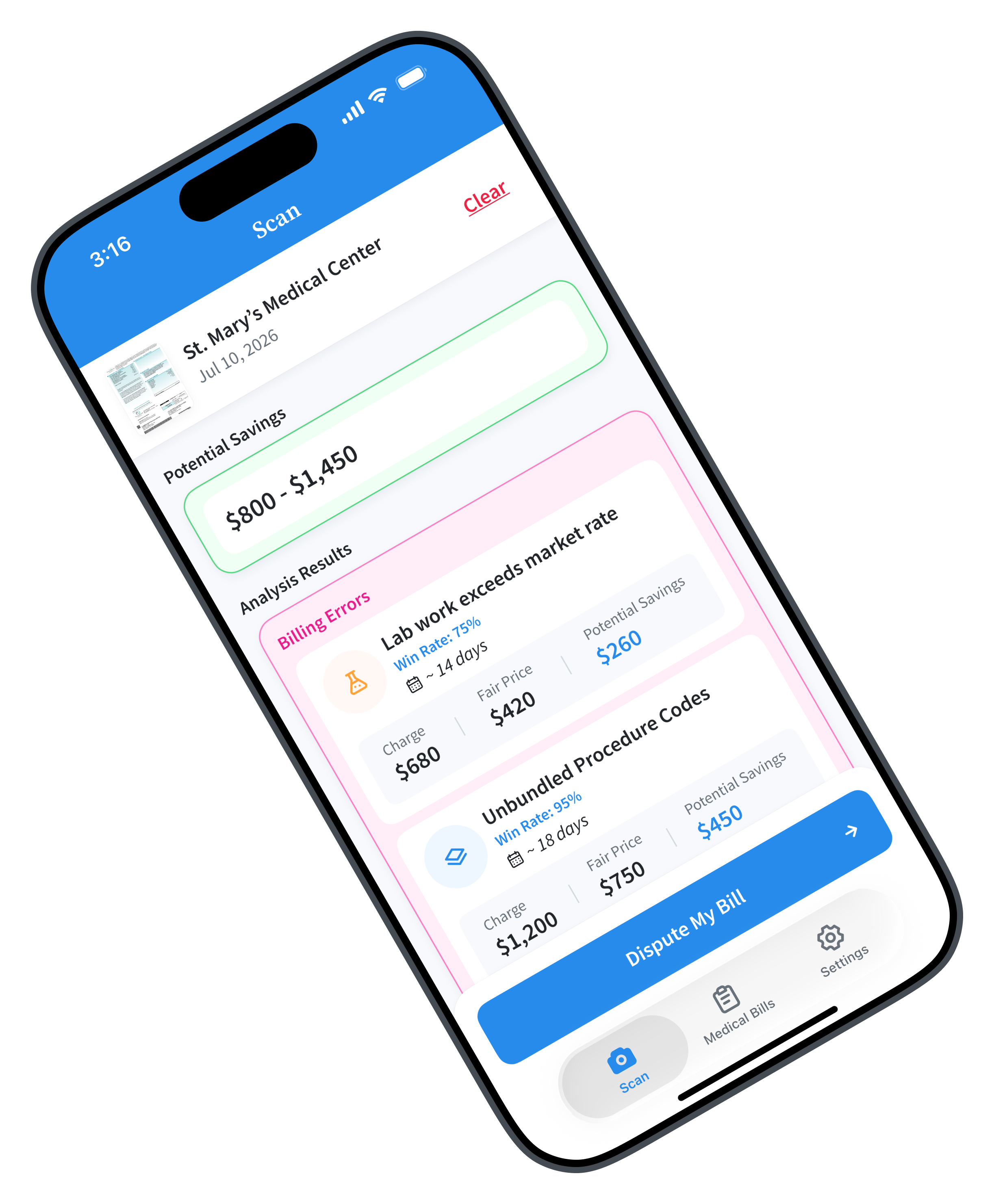
Fixing those errors first does two things. It lowers the amount you might owe, and it makes any financial assistance application cleaner, because you are asking for help with a bill that is accurate rather than one padded with mistakes. That is the part MedAdvocate is built to help with. If you spot a charge that is wrong, here is how to dispute a medical bill before you apply, and for a large or complex bill you can weigh hiring a medical bill advocate.