How to Read a Hospital Bill
To read a hospital bill, start with the itemized version rather than the summary, since only the itemized bill lists every service on its own line with a date, a description, a code, a quantity, and a price. Work down the lines and check that each date falls inside your actual stay, each quantity matches what you received, and each code describes the service you got. If you have insurance, read the itemized bill next to your explanation of benefits, because that is where mismatches between what was charged and what your plan allowed tend to show up.
The documents you might receive
The paper that arrives after a hospital visit is not always the same document, and knowing which one you are holding changes what you can do with it. There are four you are likely to run into.
- The summary bill. The short statement most people get first. It groups charges into a few broad categories and shows one balance due. It is enough to know what is owed, but not enough to check the charges.
- The itemized bill. The full version, with every service, supply, and medication on its own line with a date, a description, a code, a quantity, and a price. This is the document you want for reading and checking a bill. Here is how to request an itemized hospital bill if you only received a summary.
- The UB-04 form. The standard institutional claim form, also known as the CMS-1450, that hospitals use to bill insurers. It is maintained by the National Uniform Billing Committee and packs the charges into numbered boxes called form locators. You will not always see it, but the codes on it are the same ones that flow onto your itemized bill.
- The explanation of benefits. If you have insurance, your plan sends an EOB showing what the provider charged, what the plan allowed and paid, and what you owe. It is not a bill. Reading it next to the itemized statement is how mismatches surface, and our guide to what an EOB is breaks down each amount.
For reading a bill, the two documents that matter most are the itemized bill and, if you are insured, the EOB. Request the itemized version whenever the summary is all you have.
The anatomy of a hospital bill
Once you have the itemized bill, the layout follows a pattern. Reading it is mostly a matter of knowing what each column is telling you.
Header and account details
The top of the bill carries your name, the account or medical record number, the provider, and the guarantor, which is the person responsible for payment. Confirm these are yours before anything else, because a mixed up account is where some of the worst errors begin.
Dates of service
Every line has a date. These should fall within the days you were actually at the hospital. A charge dated to a day you were not there, or a room charge on your discharge day, is worth flagging.
Codes: what the numbers mean
The codes are the part that looks impenetrable, but there are only a few families, and you do not need to memorize them to use them.
- CPT and HCPCS codes. Five character procedure codes that describe a specific service, such as an office visit, an x ray, or a lab test. CPT covers most professional services, and HCPCS covers supplies, drugs, and some other items.
- Revenue codes. Three or four digit codes that sort each line into a department or category, such as room and board, pharmacy, laboratory, or the emergency room. They sit next to the charge on a UB-04 form and help you see what a line is for.
- Diagnosis codes. ICD-10 codes that describe the condition being treated. They explain why a service was provided, which matters when an insurer decides whether to cover it.
Quantities and charges
Each line also shows a quantity and a price. Quantity is a common place for errors, since a single dose or supply can be entered as several. The charge is the hospital's list price, which is often far higher than what an insurer or a cash payer actually pays, so a large number is not proof of an error, but it is a reason to keep reading.
What is a facility fee
A facility fee is a charge for the use of the hospital itself, meaning the room, the equipment, the staff, and the overhead, billed separately from the fee for the clinician who actually treated you. On one visit you can see two charges for what felt like one appointment: a professional fee for the provider and a facility fee for the building.
Facility fees are common and generally legitimate, and they show up most often at hospital owned outpatient clinics and in emergency departments. What surprises people is that the same care at an independent practice would not carry one. If a routine visit at a hospital owned office produced a large facility fee, it is fair to ask what the fee covers and whether you were told about it in advance. The charge itself is allowed, but the size of it is a reasonable thing to question. Facility fees are a large part of why an emergency room bill runs so high.
Observation vs inpatient status
Observation is an outpatient billing status, and whether your stay is labeled observation or inpatient usually changes what you owe, even when the care felt identical and you spent the night in a hospital bed. It is worth checking which status applied to your stay, because it drives the math on the bill.
The distinction matters most for Medicare patients, where the rules are specific. For someone on Medicare, an inpatient admission is billed under Part A, while an observation stay is billed as outpatient care under Part B, which can carry different out of pocket costs and may not cover the drugs you receive. Observation days also do not count toward the three day inpatient stay that Medicare requires before it will pay for follow up care in a skilled nursing facility. Because the status has these consequences, hospitals must give Medicare patients a written notice, called the Medicare Outpatient Observation Notice or MOON, when observation runs beyond 24 hours.
If you were kept for a long time and later learn you were on observation status, it is reasonable to ask why the stay was not an inpatient admission, and to check whether you received the required notice.
What is upcoding
Upcoding is when a service is billed at a higher, more expensive level than the care that was actually delivered. It is one of the more common ways a bill drifts upward, and it is easy to miss because the code looks ordinary until you know what it represents.
Emergency room visits are the clearest example. An ER visit is billed at one of five levels using the CPT codes 99281 through 99285, where the level is meant to reflect how complex the visit was, and a higher level means a higher charge. A short, simple visit for a minor issue billed at the top level is the kind of mismatch that signals upcoding. You cannot always tell from the code alone, but when the billed level seems out of step with what happened, it is a fair question to raise with the billing department.
Trauma activation fees and other charges that surprise people
A trauma activation fee is a charge for assembling the hospital's trauma team when it is alerted, usually by paramedics, that a seriously injured patient is on the way. Mobilizing that team is expensive, and the fee reflects it. Studies of trauma centers have found the fee commonly runs into the thousands of dollars, with a wide range from around one thousand to well over sixty thousand depending on the center and the level of activation.
The fee is legitimate when a trauma team was genuinely activated for a major injury. It becomes questionable when it appears after a minor injury where no full trauma response took place. If you see a large trauma activation fee and you were not treated by a mobilized trauma team, that is worth asking about. Other charges that catch people off guard include separate professional fees from doctors you do not remember meeting, such as a radiologist who read a scan, and supply charges for routine items at prices far above what they cost outside a hospital.
Hospital bill decoder
Pick a line item you are looking at to see what it is, whether it is usually legitimate, and what to check. This is a quick reference, and nothing you tap leaves your device.
Common medical billing errors and how to spot them
Reading a hospital bill is worth the effort because medical billing errors are common, and most of them are visible once the bill is itemized. As you go line by line, the patterns worth watching for are:
- Duplicate charges, where the same service or supply appears twice, sometimes under slightly different descriptions.
- Services not received, a charge for a test, a room, or an item you never got.
- Wrong quantities, a count that is higher than what you actually used.
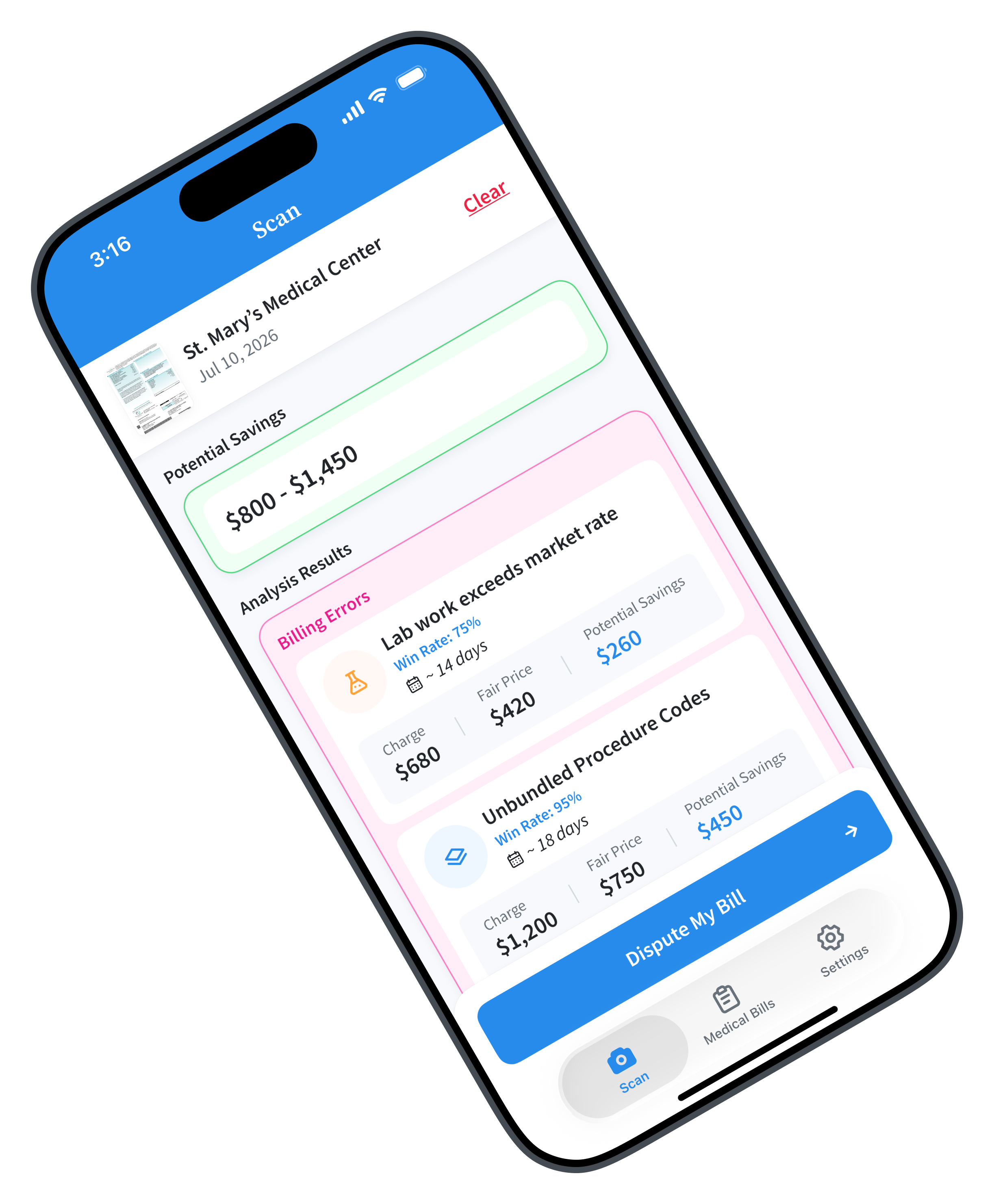
- Upcoding and unbundling, a visit billed at too high a level, or one procedure split into several priced lines.
- Charges that do not match your EOB, where the bill asks for more than your plan says you owe.
For a closer look at what these errors look like on a real statement, see the red flags in our itemized bill guide. When you find a charge that looks wrong, the next step is to put it in writing, and our guide to how to dispute a medical bill walks through the process with a free dispute letter.
Reading the bill also tells you what to do next. If the charges are correct but the total is more than you can pay, look into a hospital's financial assistance or charity care. If an unpaid bill is moving toward a collector, know what to expect from medical bills and collections. And if the bill is large or complicated enough that you would rather hand it off, a medical bill advocate can review and negotiate it for a fee.