Itemized Hospital Bill: How to Request One and What to Look For
A short summary bill rarely shows what you were actually charged for. An itemized statement breaks the total into individual lines, and that detail is where billing mistakes tend to surface.
What an itemized hospital bill is
The bill most people receive after a hospital visit is a summary. It lists a few broad categories and one large balance due. An itemized bill is the full version. It lists every service, supply, medication, and fee on its own line, along with the date, a description, a billing code, the quantity, and the price for each item.
The difference matters because a summary hides detail. When charges are grouped into one number, you cannot tell whether a service was counted twice, billed at the wrong level, or added for something you never received. The itemized version puts each charge in the open where you can check it. Other bills reward the same detail, including an ambulance bill, where an itemized breakdown reveals the base rate, the mileage, and the level of service.
Your right to request an itemized bill
You can ask for an itemized statement for your own care. Under the federal privacy rule known as HIPAA, patients have the right to access their medical records, and the billing detail for your account is part of that information. Many hospitals also provide an itemized bill on request as a matter of policy, and a number of states have their own rules that support the request.
Asking for an itemized statement is a routine request. You do not need to give a reason, and you do not need to dispute anything to receive one. This page is general information and is not legal advice.
How to request an itemized hospital bill
By phone
Call the billing number printed on your statement and keep it simple. A script that works well:
"Hello, my name is [your name] and I am calling about account number [account number]. I would like to request a fully itemized statement for my visit on [date of service]. Please include the billing code and price for every line. Can you send that to the address on file?"
Write down the date you called, the name of the person you spoke with, and any reference number they give you.
In writing
A written request creates a record and is easy to follow up on. You can use the generator below to fill in your details and produce a letter you can copy or print.
Request letter generator
Enter your details. The letter updates as you type. Nothing you enter leaves your device.
How long it takes and when you can ask
Most hospitals can produce an itemized statement within one to two weeks. The detail already exists in their billing system, so the wait is about generating and sending the document, not creating it. If a month passes with nothing, follow up in writing and reference your original request date.
You can request an itemized bill at any point, including after you have already paid. If a review of the detail turns up a charge that should not have been there, you can still ask the billing department to review it and refund the difference. There is no requirement to make the request before paying. If the charges are accurate but the total is more than you can pay, here is how to negotiate a hospital bill.
How to read an itemized bill
CPT codes
Most lines carry a five digit code called a CPT code, which stands for Current Procedural Terminology. These codes describe the specific service that was billed. You can search a code online to see what it represents, then check that the description matches the care you actually received.
You do not need to memorize the codes. Search the code number along with the words procedure code, and you will usually find a plain description of what it covers. Compare that description to what you remember. If the code points to a service you did not receive, or a more involved version of what you had, mark the line for a closer look.
How to read a single line
Every line follows the same pattern, so it helps to read one closely before you scan the rest. Take a sample line for a routine blood test:
85025 | Complete blood count | Quantity 1 | $95.00
Read it from left to right. The code, 85025, identifies the exact service, here a complete blood count. The description next to it should plainly match that code and the care you remember. The quantity shows how many times the service was billed, so a quantity of one means it was counted once. The charge is the price for that single line. Before you move on, confirm three things: the description fits the code, the quantity matches what actually happened, and the same line does not appear again somewhere else on the bill.
Common red flags
Once you have the detail in front of you, watch for these patterns.
- Duplicate charges The same service or supply billed more than once. Scan for repeated lines on the same date.
- Upcoding A charge listed as a more complex or costly service than what took place. The code points to a higher level of care than you received.
A common example: emergency room visit levels
Emergency room visits are billed at one of five levels, from CPT 99281 for the simplest visits to 99285 for the most complex. The level is supposed to reflect the complexity of the care documented in your record. A visit for a minor issue that resolves with a basic exam and simple treatment will usually sit at 99282 or 99283. When a straightforward visit is billed at 99284 or 99285, the difference can be hundreds of dollars. If your bill shows a high level code and your visit felt routine, that line is worth a question. You can compare the code against your visit summary or medical record. For what an emergency visit costs and how to check the whole emergency room bill, see our ER bill guide.
- Unbundling Charges that belong together as one code split into several separate lines, which can raise the total.
- Phantom charges Lines for services, supplies, or medications you never received, such as a room you were not in or a test that was not run.
More red flags to check
Beyond duplicates and upcoding, a few other patterns are worth a careful look.
Incorrect quantity. A line that shows more units than you received. If a bill lists four doses of a medication when you were given one, the extra three inflate the total. Match each quantity against your own memory or your medical record.
Balance billing. When a provider in your network bills you for the gap between the billed amount and the allowed amount. Your plan already wrote that gap off, and you can confirm the allowed amount on your explanation of benefits. If a line asks you to pay the full charge instead of your share, question it.
Canceled or self administered items. Charges for a test that was ordered and then canceled, or for supplies and medications you handled yourself. If it did not happen, it does not belong on the bill.
Room and board mismatch. A charge for a private room when you stayed in a shared room, or for more days than you were actually admitted. Compare the room type and the number of days to what you used.
Reading a bill this way, one line at a time, is slow, but it is how errors surface. Most mistakes hide in a single line that does not match your care, and the only way to catch them is to check each one against what you remember. For the facility fees, revenue codes, and other hospital specific charges you may run into, see our guide to how to read a hospital bill.
What to do when you find an error
If a line looks wrong, you do not have to pay it before it is reviewed. A calm, organized approach tends to move things along:
- Circle each line you have a question about and note why it looks off.
- Call the billing department and ask them to explain the charge. Sometimes there is a reasonable answer, and sometimes there is not.
- Ask for any correction in writing, and put your own request in writing as well so there is a record.
- If you have insurance, compare the bill against the explanation of benefits from your insurer and flag anything that does not match.
- Keep notes of every call, including the date, the name of the person, and what was said.
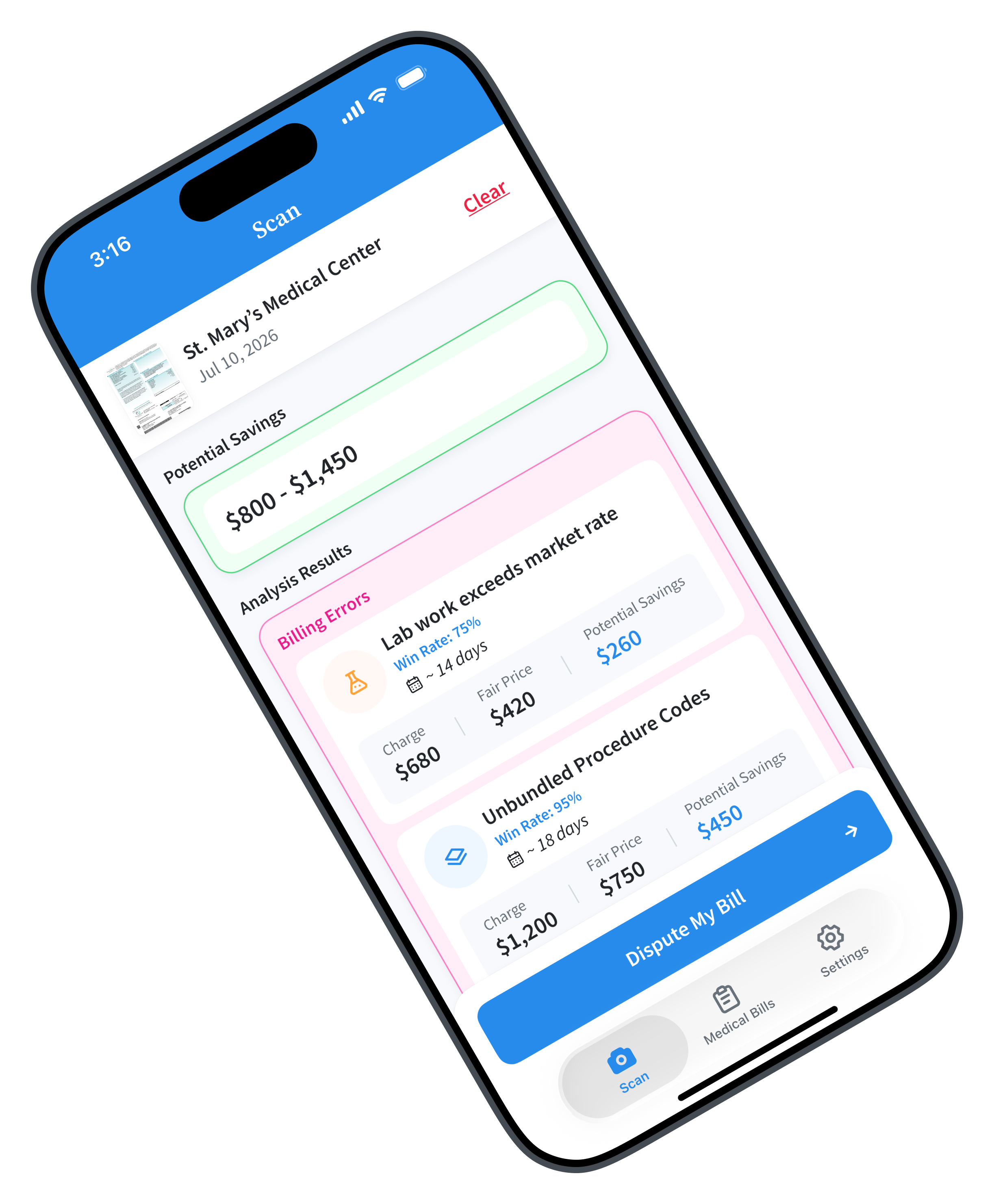
Reviewing an itemized bill line by line takes patience, and the codes are not written for patients. That is the part MedAdvocate can help with. And if a bill is already heading to collections, you keep the right to dispute a charge that is wrong; here is what to know about medical bills and collections. And if the amount is more than you can afford, you may qualify to have part or all of it forgiven through hospital financial assistance; here is how medical bill forgiveness works.
If the hospital stalls or refuses
Most requests are filled without friction, but if yours goes nowhere, keep the pressure polite and in writing. Send a short letter or portal message restating the request, the date you first asked, and the account number. Ask for a written response by a specific date.
If that fails, ask to speak with a patient advocate or a billing supervisor. Larger hospitals have staff whose job is resolving exactly this kind of issue. You can also check your state attorney general or state health department website, since many states have their own rules about billing transparency and a complaint process when providers do not respond. Keep copies of everything you send and receive. If the itemized bill turns up a charge that is wrong, our full guide to how to dispute a medical bill walks through the whole process, including a free dispute letter. For a large or complicated bill, you can also weigh hiring a medical bill advocate.