Medical Bill Advocate: What They Do, What They Cost, and When to Hire One
A medical bill advocate is a professional who reviews, disputes, and negotiates medical bills on your behalf. Hiring one is a genuinely good move for some bills and overkill for others. There are three ways to fight a bill: do it yourself for free, use an app to do the heavy lifting, or hire a human advocate. This guide lays out what advocates do, what they charge, and how to tell which path fits your situation.
What a medical bill advocate does
A medical bill advocate, also called a medical billing advocate or a patient advocate for medical bills, works on the billing side of your care rather than the clinical side. The core of the job is a medical bill audit: going through your itemized bill line by line to find charges that are wrong, duplicated, or inflated, the same review you can learn to do yourself by reading how to read a hospital bill. From there, most advocates offer some mix of the following:
- Auditing the bill. Reading the itemized bill against the care you received to catch duplicate charges, services you never got, wrong quantities, and coding that inflates the total.
- Negotiating the balance. Medical bill negotiation services can lower a bill even when there is no clear error, for example by moving charges from the list price toward the rates insurers and cash payers typically pay, the same moves you can make yourself with our guide to how to negotiate a hospital bill.
- Appealing insurance denials. Handling the paperwork and deadlines when a claim was denied or underpaid, and pushing the insurer to reprocess it.
- Arranging payment plans. Setting up a manageable plan, sometimes interest free, or pointing you toward financial assistance you qualify for.
Advocates come from different backgrounds. Some are former medical coders or billers, some are nurses, and some are attorneys who focus on billing disputes. They tend to serve people facing large or complicated bills, long hospital stays, or a stack of statements from many providers that is hard to track alone.
What a medical bill advocate costs
There is no single medical bill advocate cost, because advocates price their work in a few different ways. Understanding the models is the key to knowing whether hiring one makes financial sense for your bill.
- Contingency, a percentage of savings. The most common model for bill reduction. The advocate takes a share of what they save you, typically around 25 to 35 percent, with the broader market running from roughly 15 to 50 percent. Usually there is no upfront cost, and nothing is owed if they save nothing.
- Hourly. Often 75 to 350 dollars an hour, common for complex cases, insurance appeals, or situations where the savings are hard to measure.
- Flat or per project fee. Often 300 to 1,500 dollars for a bounded task, such as reviewing a single bill or drafting one appeal letter.
- Retainer. A recurring fee for ongoing help, more common for people managing chronic or complex care over time.
Contingency pricing cuts both ways. In your favor, you pay only if the advocate delivers a reduction, which lowers your risk. Against you, a large percentage of a large reduction can be a real amount of money. If an advocate cuts a 40,000 dollar bill by 20,000 dollars at a 30 percent fee, that is 6,000 dollars, and it is still a good outcome. On a smaller bill with a small error, the same percentage may be more than the job is worth to you. Most advocates offer a free initial consultation, and it is wise to get the fee agreement in writing before any work begins. The calculator below shows how these numbers play out at your bill size.
Cost comparison calculator
See the typical cost of each option at your bill size. Nothing you enter leaves your device.
When hiring a human medical bill advocate is worth it
For some situations, a human advocate is the right call, and it is worth saying that plainly. The fee can be money well spent when the bill is big enough, tangled enough, or draining enough of your time that expert help pays for itself. Cases where hiring an advocate tends to make sense:
- Large or high dollar bills. When the total runs into the tens of thousands, even a modest percentage reduction can far outweigh the fee.
- Complex or extended care. Long hospital stays, surgeries, or care from many providers produce stacks of bills and explanations of benefits that are hard to reconcile alone.
- Ongoing disputes. A denial that has already been appealed once, a bill that keeps coming back, or an account that has moved to collections, a stage our guide to medical bills and collections covers, can take persistence and know how that an advocate has.
- No time or capacity. If you are recovering, caring for someone, or simply cannot take on hours of calls and letters, handing the work to someone else has real value.
Hiring an advocate does not replace the other help you may qualify for. A good advocate will also check whether you are eligible for a hospital's financial assistance or charity care, which can reduce or erase a balance based on your income, separate from any negotiation.
When an app or a do it yourself approach fits better
For a great many bills, you do not need to hand over a share of the savings to get a good result. The steps an advocate takes on a straightforward bill are steps you can take yourself, and the same process is what an app can automate for a flat, low cost. A DIY or app approach usually fits when:
- The bill is a typical size rather than a five figure hospital balance.
- The care was a single visit or a short, contained episode.
- The errors are clear and countable, such as a duplicate line or a charge that does not match your explanation of benefits.
- You are cost sensitive and a percentage fee would eat much of the savings.
The core moves are the same ones a professional makes: request the itemized bill, compare it to your EOB, identify the errors, and put a written dispute in front of the provider. Our step by step guide to how to dispute a medical bill walks through the entire process and includes a free dispute letter you can send yourself.
Do it yourself vs MedAdvocate vs a human advocate: an honest comparison
The three approaches are not competitors so much as different tools for different bills. Here is how they compare on cost, speed, effort, and the situations each one fits best.
Do it yourself
Cost: Free, plus your time.
Speed: Depends on you and the provider.
Effort: Highest. You make the calls and write the letters.
Best fit: Typical bills, clear errors, and time to spend.
MedAdvocate
Cost: Flat 29 dollars, one time.
Speed: Analysis in seconds, letter mailed for you.
Effort: Low. You upload the bill and review the result.
Best fit: A bill or two you want analyzed and disputed without doing the writing.
Human advocate
Cost: Often 25 to 35 percent of savings, or hourly or flat fees.
Speed: Days to weeks, depending on the case.
Effort: Low for you once you hand it over.
Best fit: Large, complex, or drawn out cases.
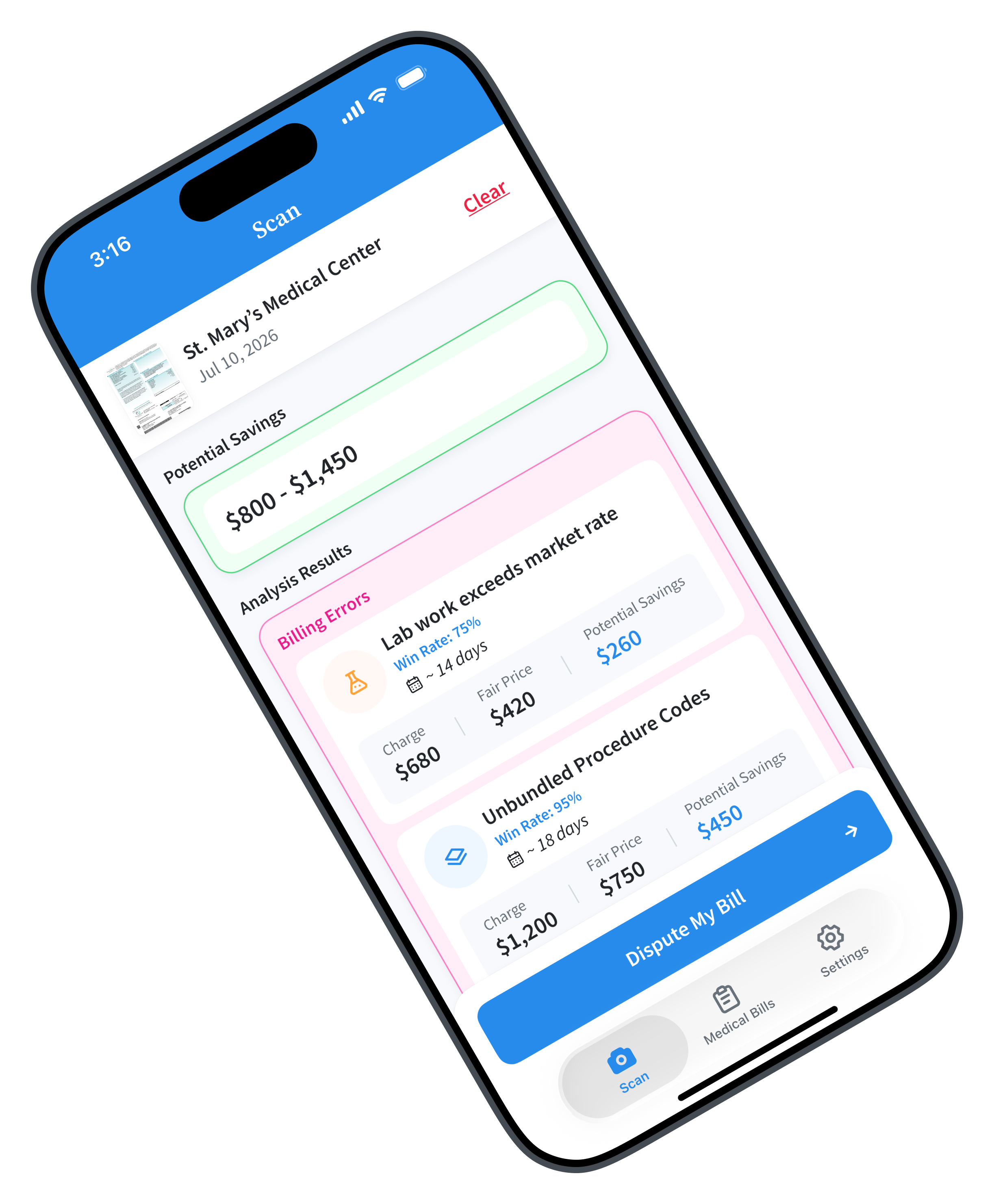
MedAdvocate is the middle path. For a flat 29 dollars it analyzes your actual bill, flags the charges worth questioning, and writes and mails a dispute letter by certified mail on your behalf, without taking a percentage of anything you save. It does not replace a human advocate on a huge, complicated case, and it is not meant to. It fills the gap between doing everything yourself and paying a share of the savings on a bill that does not need that level of help.